Metric One
Two doorways, one interior passage. Metric One specifies the human interface for a traversable throat, then works backward through the geometry, required source and measurements that would make such a passage physical.
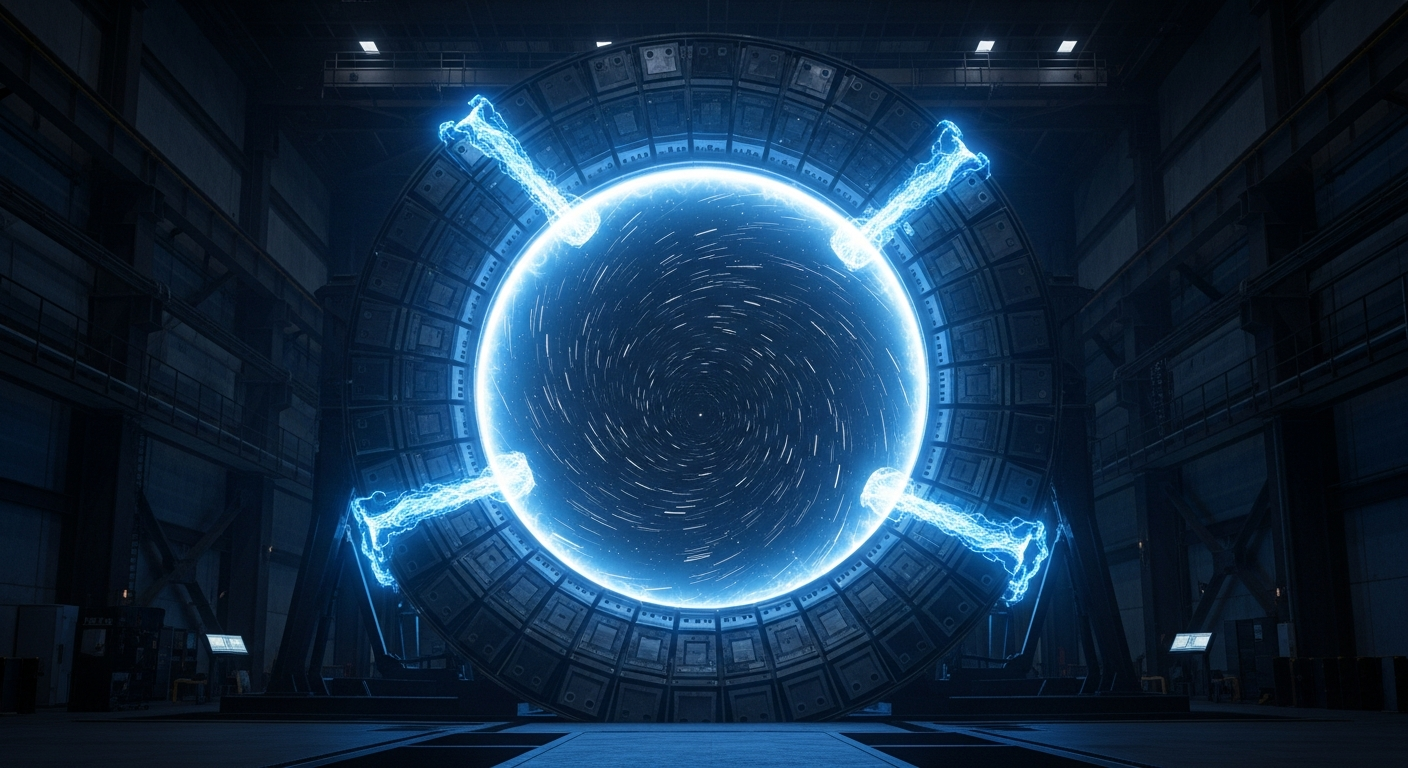
A short passage instead of a long journey.
The intended experience is a local walk between distant sites, without disassembling a traveler or transmitting a reconstruction. A terminal pair would share one interior route. The surrounding frame would provide access control, environmental separation, instrumentation and an exclusion boundary around the passage.
The central distinction is between specifying a geometry and producing the matter that sustains it. The former can be calculated. The latter has no demonstrated implementation for this design. A short interior distance alone establishes neither arbitrary operating range nor secure access, stable deployment or safe transit.
Prepare a physically admissible source and its geometry.
Resolve stability, clocks, environmental loads and traveler forces.
Operate access and containment only within a demonstrated envelope.
Dashed process rules mark design targets. None is a record of a completed Metric transit.
Metric One / Hub
One paired pedestrian passage, or a gallery of independent pairs. Hub capacity follows the number and destination of physical connections; it is not supplied by a routing algorithm.
Metric Node / Reach
Municipal and remote-endpoint deployment studies. Larger apertures, moving mouths and cargo introduce separate source, structural, causal and safety requirements; they are not qualified variants of the pedestrian study.
Specify the interior before discussing its source.
Use a static, spherically symmetric example from the Morris–Thorne framework, written in proper radial distance. The same example and its stress tensor are given explicitly in Ford and Roman, §4.1. The throat is at ℓ = 0; each side extends toward an asymptotically flat region.
Calculated geometry. This corresponds to Φ = 0 and b(r) = r₀²/r. A finite redshift function avoids a horizon in this specified metric. It does not demonstrate formation, stability or a material source. Spatial curvature remains nonzero at finite distance; asymptotic flatness is not an exactly flat room a few radii away.
The four-meter interval is a selected pair of stations, not a universal multiple of throat radius. The example has zero static-frame time-space curvature components, but a moving traveler samples spatial curvature and can experience transverse tides. Human transit requires a trajectory, velocity and body-scale geodesic-deviation calculation. It is not assigned a zero-force rating.
The field equation is a requirement, not a supply specification.
For the chosen geometry, the local orthonormal-frame energy density ε, radial pressure pᵣ and transverse pressures pₜ obey the following relation. The SI factor c⁴/G restores the dimensions of energy per volume to Ford–Roman equation 48.
Calculated for r₀ = 1.524 m. The corresponding mass-equivalent density is ε/c², approximately −2.31 × 10²⁵ kg/m³. These are not interchangeable units. This example requires ε + pᵣ < 0 along a radial null direction. It needs the entire spatially distributed stress tensor, not merely a negative number in one cavity.
A useful independent comparison is the ideal parallel-plate Casimir interaction. At zero temperature with perfectly conducting, laterally extensive plates separated by a, the interaction energy per area gives:
| ASSUMED PLATE GAP | CALCULATED INTERACTION ENERGY DENSITY | CALCULATED PRESSURE |
|---|---|---|
| 1 µm | −4.33 × 10⁻⁴ J/m³ | −1.30 × 10⁻³ Pa |
| 100 nm | −4.33 J/m³ | −13.0 Pa |
The table is an ideal-model calculation, not the best laboratory result and not a usable source specification. Conductivity, temperature, geometry and surface conditions matter for real apparatus. Its plates and supports also carry energy and stress. A cavity interaction energy cannot be substituted for the required macroscopic, self-consistent gravitational source.
The missing physical bridge.
General-relativistic solutions, quantum negative-energy effects and measured Casimir forces do not together establish a permissible macroscopic wormhole source. Ford and Roman derive severe magnitude/duration restrictions for a specified quantum field and explain their local-curvature and boundary assumptions. Their constraints are not a universal “orders of magnitude” surcharge that can be added to an arbitrary laboratory comparison.
Jaffe's analysis also distinguishes the observed force from a unique inference about absolute vacuum energy. A favorable force measurement would not by itself measure the tensor required by the throat.
Keep each result inside its demonstrated regime.
Static cavity boundaries
Surface-force metrology tests material response and boundary models. Geometry optimization may change force and interaction energy; it must not be counted as a demonstrated gravitational source. The retained array study explores that proposed interface; its numerical performance claims require a separate review.
Driven quantum fields
Wilson et al. observed dynamical Casimir photons and two-mode squeezing in a superconducting circuit. The photons are powered by an external drive. Squeezing is not a standalone energy-density specification: modes, bandwidth, state, region and sampling time must be supplied.
Self-consistent semiclassical sources
A candidate must solve the geometry and the renormalized quantum stress together, including fluctuations and material boundaries. Declaring a desired stress tensor is not evidence that a quantum state realizes it.
Modified gravity / small-scale topology
These are research dependencies, not successive manufacturing steps. Any alternative theory must state its action, regime and stability; creation or capture of a microscopic throat and enlargement to this aperture are not established operations.
Separate the enclosure from the source it would contain.
The 3.048 m throat diameter is the geometry requirement, not a finished frame dimension. Structural thickness, service clearances and containment must be added outside it. A smaller mechanical opening cannot be presented as the same aperture.
| SUBSYSTEM | SPECIFIED FUNCTION | UNRESOLVED INPUT |
|---|---|---|
| Source region | Provide the required distributed stress | Physically admissible state, boundaries, materials and preparation |
| State instrumentation | Resolve geometry and disturbances | Observable, noise model and calibration; no assumed picometer throat sensor |
| Control | Maintain a demonstrated stable state | Source actuator and dynamical plant model; a generic controller does not prove stability |
| Iris / environment | Restrict entry and isolate site environments | Pressure, radiation, personnel clearance and credible fault behavior |
| Power / cooling | Supply hardware and reject dissipation | Source demand, full-cycle energy and thermal boundaries; no assigned UPS rating |
| Frame / mounting | Carry apparatus and site loads | Complete envelope, materials and source-induced stresses |
An iris is a conventional access barrier, not a demonstrated spacetime disconnect. Neither harmless collapse nor ejection of a traveler follows from the static metric. Loss of source, a body in transit and a mismatch between the two environments require explicit dynamical and safety analyses before an operating procedure can be written.
A paired route is not a global timing guarantee.
A fixed pair is modeled as one edge in a transport graph. For example, a fully connected graph of 1,000 hubs requires 999 pair connections per hub and 499,500 pairs in total. A sparser graph needs its own demonstrated diameter; approximately √N neighbors is not, by itself, proof of two-hop coverage. Leaf terminals also add their access hops.
Morris, Thorne and Yurtsever examine how hypothetical wormhole transport can create causality problems. Geographic location alone does not certify a safe time offset. A chronology monitor would report a model and measurements; its presence cannot prove that the underlying spacetime is admissible. Authentication and physical security remain ordinary engineering responsibilities, not consequences of topology.
Start with a force that an instrument can actually resolve.
The first apparatus proposed here is a vacuum surface-force experiment: a conducting spherical surface above a plate, a controlled separation, a calibrated force balance and an independent distance readout. Its task is to discriminate a boundary-force model from electrostatic, thermal and mechanical effects. It is not a curvature detector or a throat generator.
Lamoreaux's torsion-pendulum experiment supplies an external measurement precedent, with reported agreement at the 5% level in the original article. This proposal is not a claim to that result. A spherical geometry needs its own force calculation; the parallel-plate pressure table cannot be read as the force on this apparatus.
Calibration and controls
Determine force response and gap independently. Sweep applied bias, characterize residual and patch potentials, repeat separation cycles, and compare materials and surface preparation. Track drift, vibration and temperature.
Acceptance record
Retain dimensions, raw readout, calibration, uncertainty and the chosen force model. Agreement constrains the surface interaction in that regime. It does not establish negative total apparatus mass or a macroscopic gravitational source.
A high-field curvature experiment would require a separate source model and a complete noise budget. Positive electromagnetic energy does not supply this throat's negative ε + pᵣ. No DPF field strength, displacement sensitivity or successful gravitational measurement is assigned to internal hardware here.
What must connect before the terminal can exist.
| REQUIREMENT | PHYSICAL BASIS / EVIDENCE | MISSING PROOF |
|---|---|---|
| Specified pedestrian aperture | Parameterized metric and proper-distance interval | Formation, exterior matching and traveler forces |
| Admissible supporting source | Full signed stress requirement; quantum restrictions | Realizable state, total material/field tensor and self-consistent geometry |
| Vacuum-boundary model | Ideal interaction; external force experiment | Calibrated result for the actual surfaces and regime |
| Stable passage | Conservation and a specified dynamical source | Perturbation evolution, actuator coupling and failure behavior |
| Causal deployment | Published wormhole/time-machine analysis | Mouth histories, global causal structure and an admissible operating envelope |
| Installed services | Subsystem boundaries | Full-cycle power, heat, enclosure and safe access based on a demonstrated source |
The principal limitation is not just a larger power supply or a smaller plate gap. The missing result is a physically realizable, stable source–geometry solution. The geometric study remains useful because it states what that result would have to deliver.
Research interfaces, not a list of available suppliers.
Vacuum instrumentation belongs with Vapor Vacuum; material electromagnetic response with Maxwell Continuum; gravitational modeling with Aetheric Sciences; and processed surface properties with Metallic Sciences. Their proposed contributions require independent evidence and are not completed joint experiments.
Highfield's field-energy study and Stellar's power balance address different physical regimes. Neither is a qualified source for this terminal. Phase Flash and Fermat Logistics provide related thermal and transport design contexts, not established cooling or mouth-delivery services.
The existing Atlas and Casimir-array study remain separate retained design pages. Their optimizer/frontier and hardware-performance claims are not validated by this homepage. No unverified frontier graphic is used here as calculated evidence.
Primary work used in this study.
- Wormholes in spacetime and their use for interstellar travel: A tool for teaching general relativity.
Michael S. Morris and Kip S. Thorne · American Journal of Physics 56, 395–412 (1988) · DOI 10.1119/1.15620.
THEORETICAL GEOMETRY. Framework for specifying traversability and its required source. A metric solution is not a demonstration of formation, stable matter or manufactured terminals.
- Quantum Field Theory Constrains Traversable Wormhole Geometries.
L. H. Ford and Thomas A. Roman · Physical Review D 53, 5496–5507 (1996) · DOI 10.1103/PhysRevD.53.5496. Author paper, geometry and tensor on page 12.
THEORY / RESTRICTIVE RESULT. Equations 47–49 provide the selected metric, stress and curvature in geometrized units. The quantum bound concerns a minimally coupled massless scalar field and its sampling assumptions; it sharply constrains the proposed static geometries. It is not a material-independent engineering multiplier.
- On the attraction between two perfectly conducting plates.
H. B. G. Casimir · Proceedings of the Royal Netherlands Academy of Arts and Sciences 51, 793–795 (1948) · original Academy-hosted paper; no DOI supplied.
IDEAL-BOUNDARY CALCULATION. Plate interaction energy and force, used for the parameterized comparison. Infinite ideal conductors and the reference energy difference do not specify a finite supported apparatus or its gravitational tensor.
- Demonstration of the Casimir Force in the 0.6 to 6 µm Range.
S. K. Lamoreaux · Physical Review Letters 78, 5–8 (1997) · DOI 10.1103/PhysRevLett.78.5. Published erratum (1998).
MEASURED EXTERNAL FORCE. The original abstract reports a torsion-pendulum experiment and 5% agreement with theory. The force result motivates calibrated metrology, not an assertion that macroscopic negative total energy or wormhole support was measured.
- The Casimir Effect and the Quantum Vacuum.
R. L. Jaffe · Physical Review D 72, 021301 (2005) · DOI 10.1103/PhysRevD.72.021301.
CRITICAL INTERPRETATION. Shows that Casimir forces can be formulated without invoking zero-point energies. This limits what the force observation alone proves; it does not deny the observed force.
- Observation of the Dynamical Casimir Effect in a Superconducting Circuit.
C. M. Wilson et al. · Nature 479, 376–379 (2011) · DOI 10.1038/nature10561. Author paper and actual spectral/correlation figures.
MEASURED DRIVEN QUANTUM FIELD. A modulated superconducting boundary produces photons and two-mode squeezing. The external drive supplies energy; the experiment does not establish a static macroscopic source for the chosen throat.
- Wormholes, time machines, and the weak energy condition.
Michael S. Morris, Kip S. Thorne and Ulvi Yurtsever · Physical Review Letters 61, 1446–1449 (1988) · DOI 10.1103/PhysRevLett.61.1446.
CAUSAL LIMITATION. Studies the connection between hypothetical traversable wormholes and time machines, explicitly conditional on whether wormholes can be created and maintained. It does not certify terrestrial deployment.
Calculation inputs and scope
Specified throat radius 1.524 m; assumed stations ℓ = ±2 m and walking speed 4/3 m/s; comparison plate gaps 1 µm and 100 nm. Numerical inputs: c = 299,792,458 m/s, G = 6.67430 × 10⁻¹¹ m³ kg⁻¹ s⁻² and ℏ ≈ 1.054571817 × 10⁻³⁴ J s. The complete-graph example assumes N = 1,000. Displayed results are rounded after calculation.
- The throat's negative source requirement is calculated for one explicit metric, not for every possible wormhole.
- The proper-distance interval sets the timing; no external-room matching construction is supplied.
- The plate comparison is a zero-temperature idealization; it is not a measured record or an optimized material result.
- No complete source, throat-control plant, safe collapse mechanism or installed terminal is demonstrated.
- The proposed apparatus measures boundary forces. A gravitational inference needs additional theory and evidence.
Configuration studies and reading candidates.
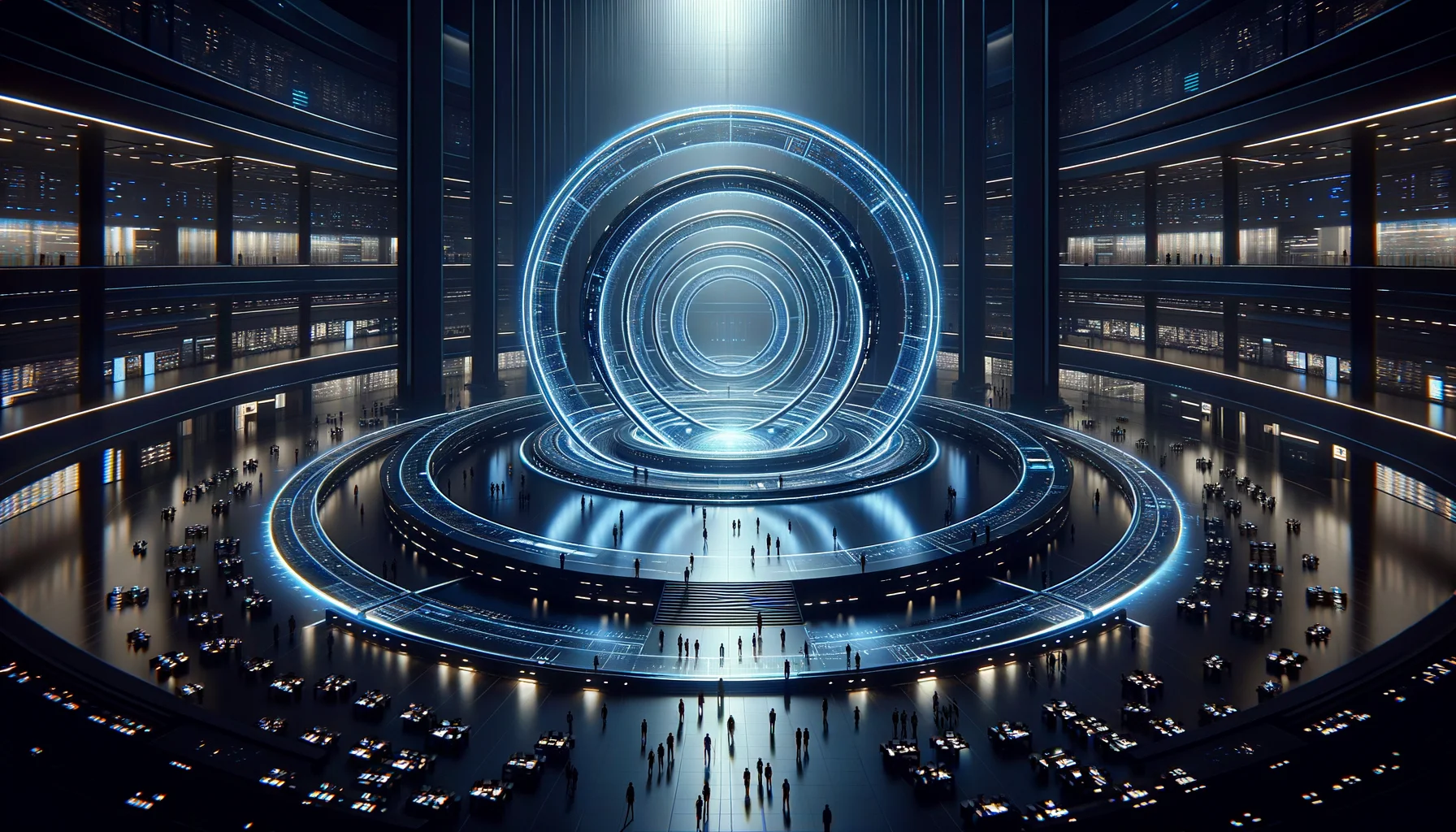
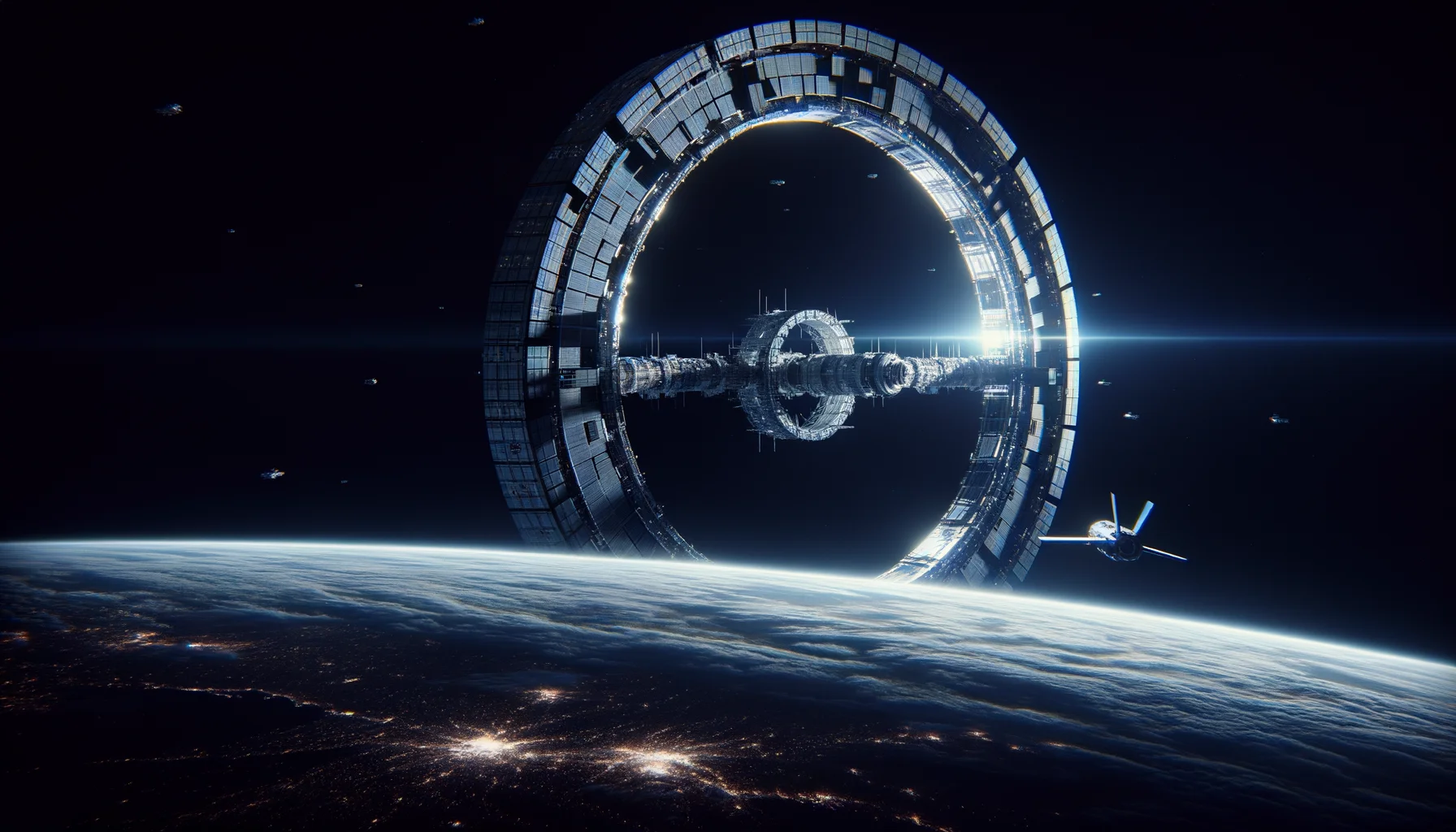
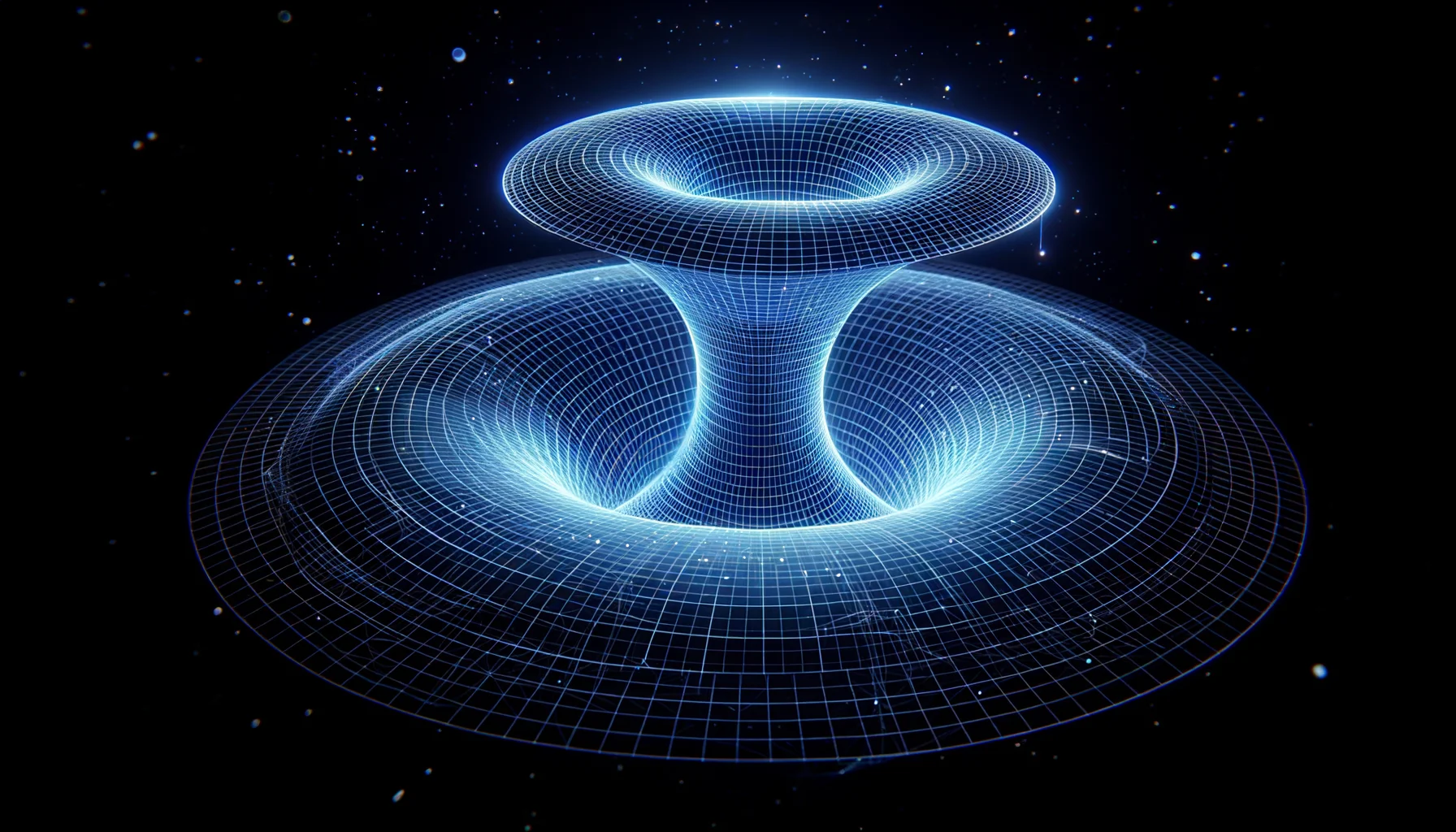
Additional artwork records deployment ideas, not laboratory observations. The unverified reading list remains available for source review; it is separate from the seven papers actually used above.
Open retained configuration artwork
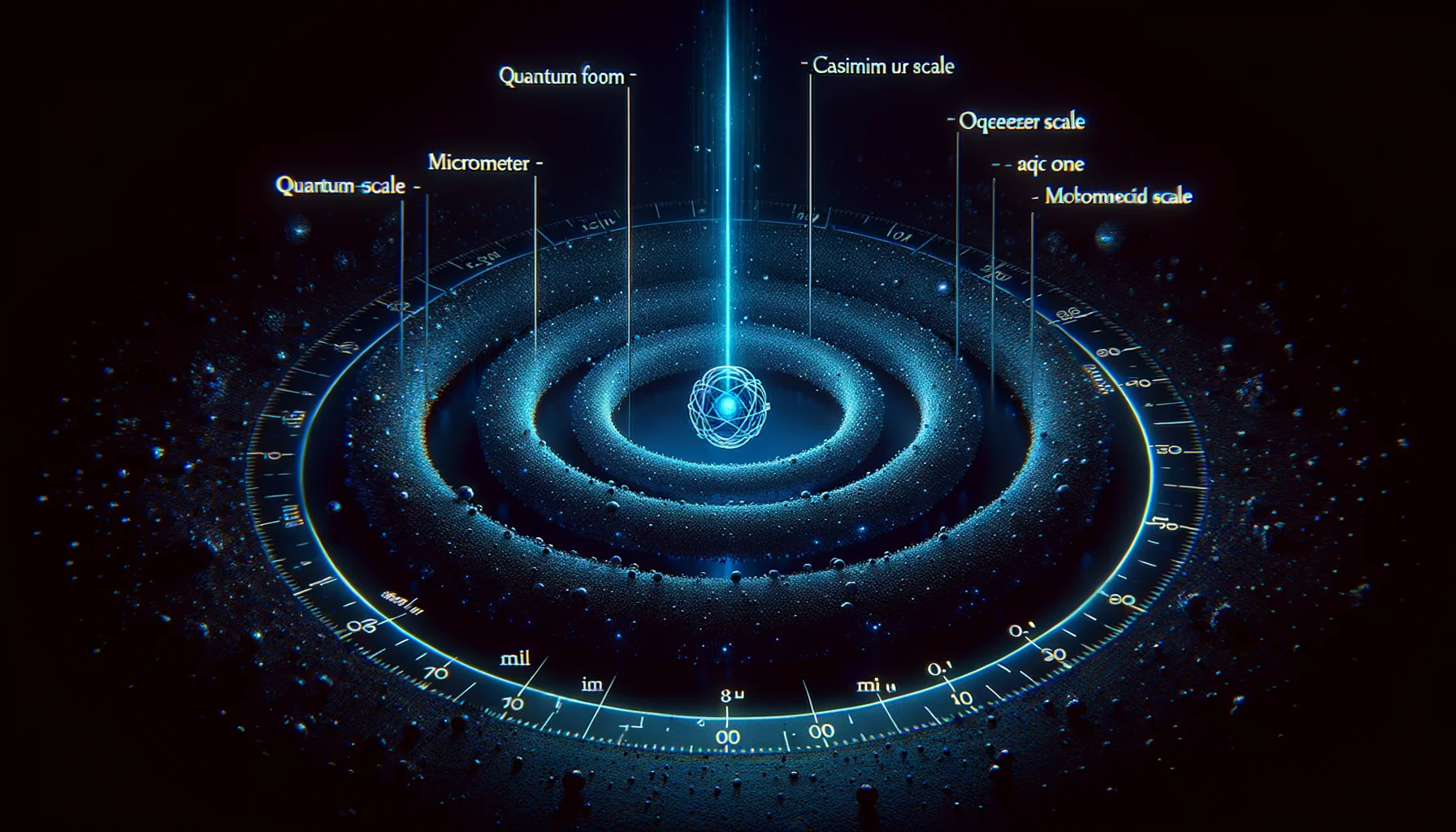
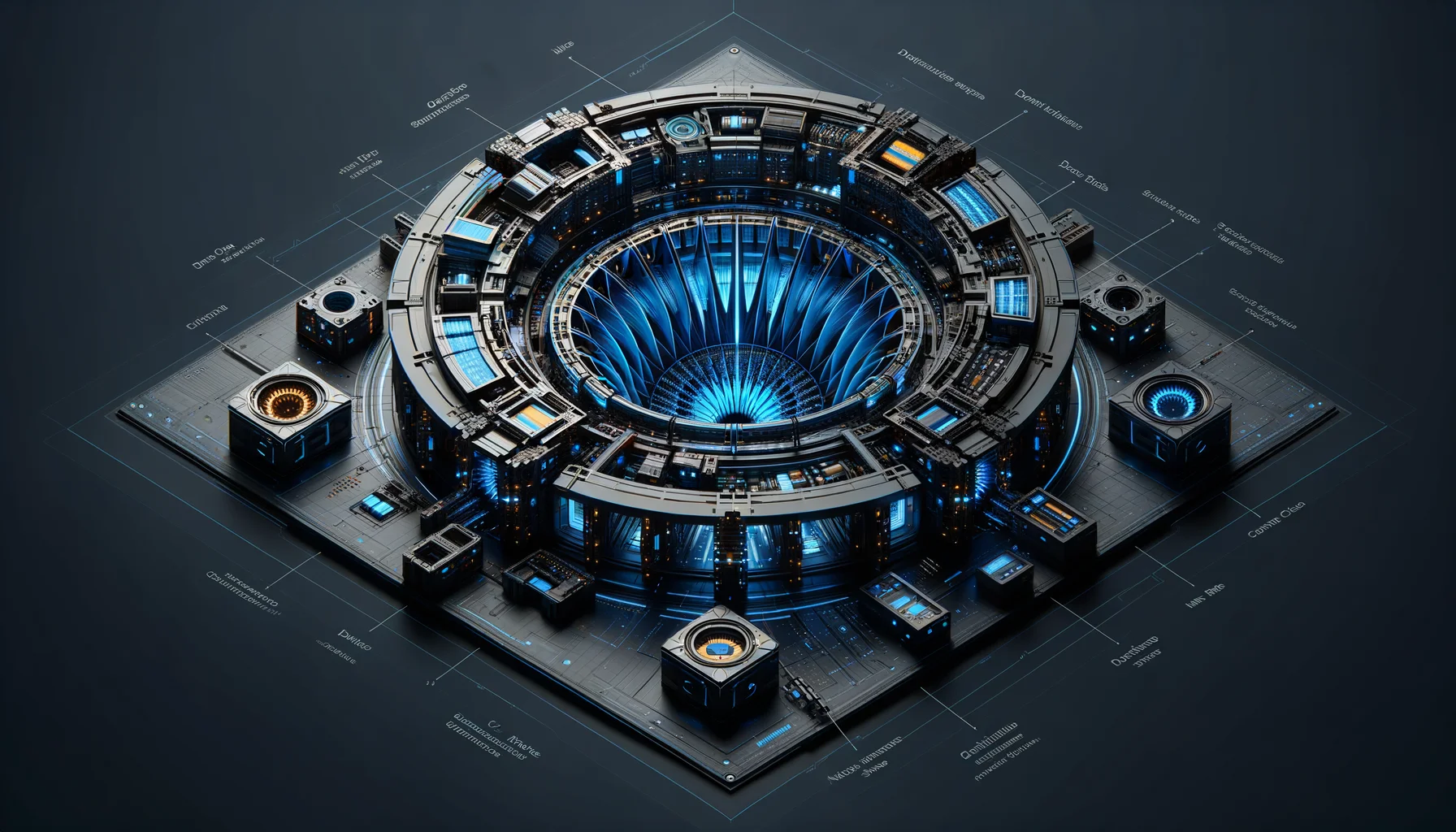
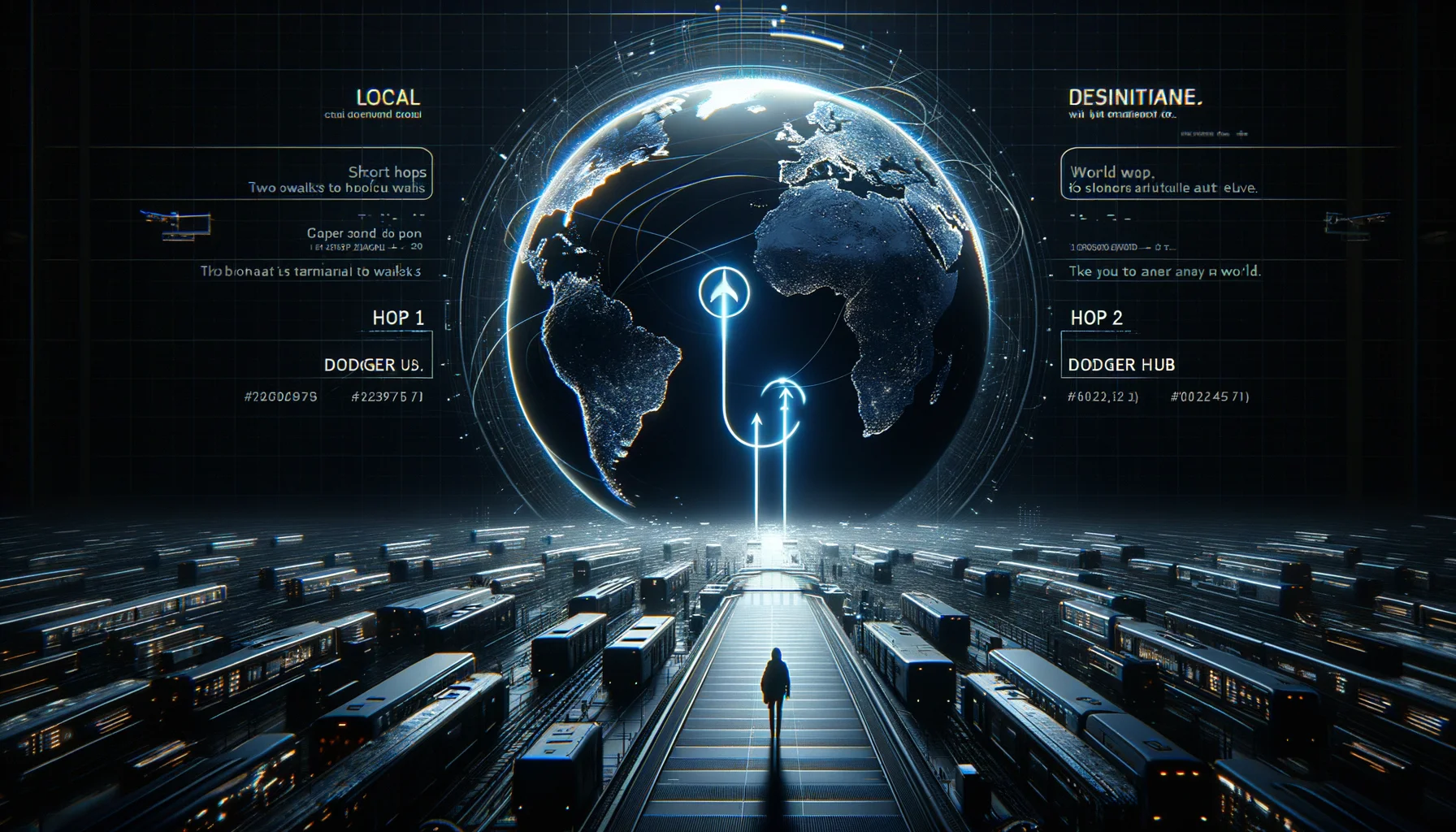
These renderings are not measurement records or numerical field solutions. Embedded text and scales are unverified; the study calculations and stated requirements govern.



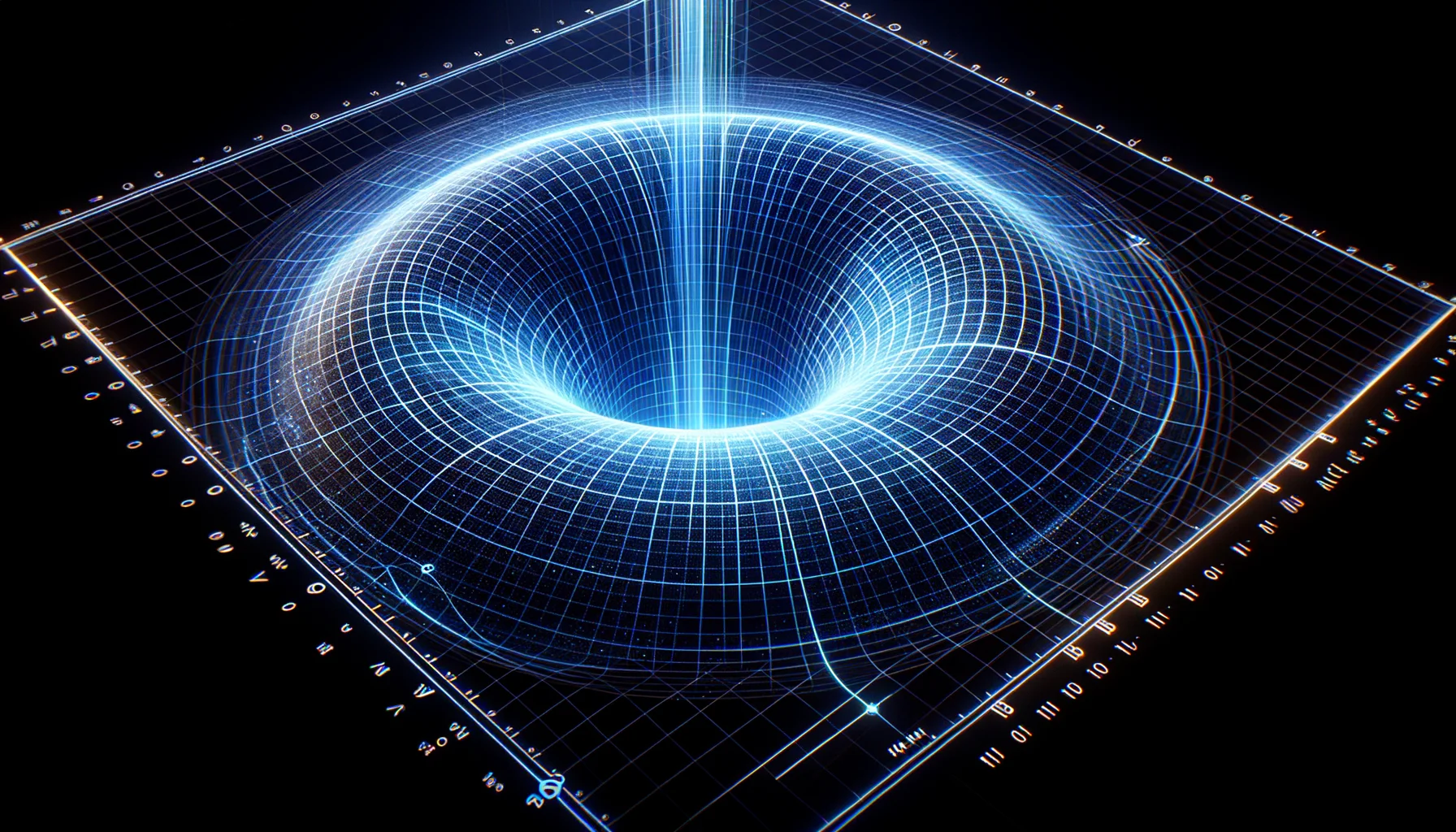
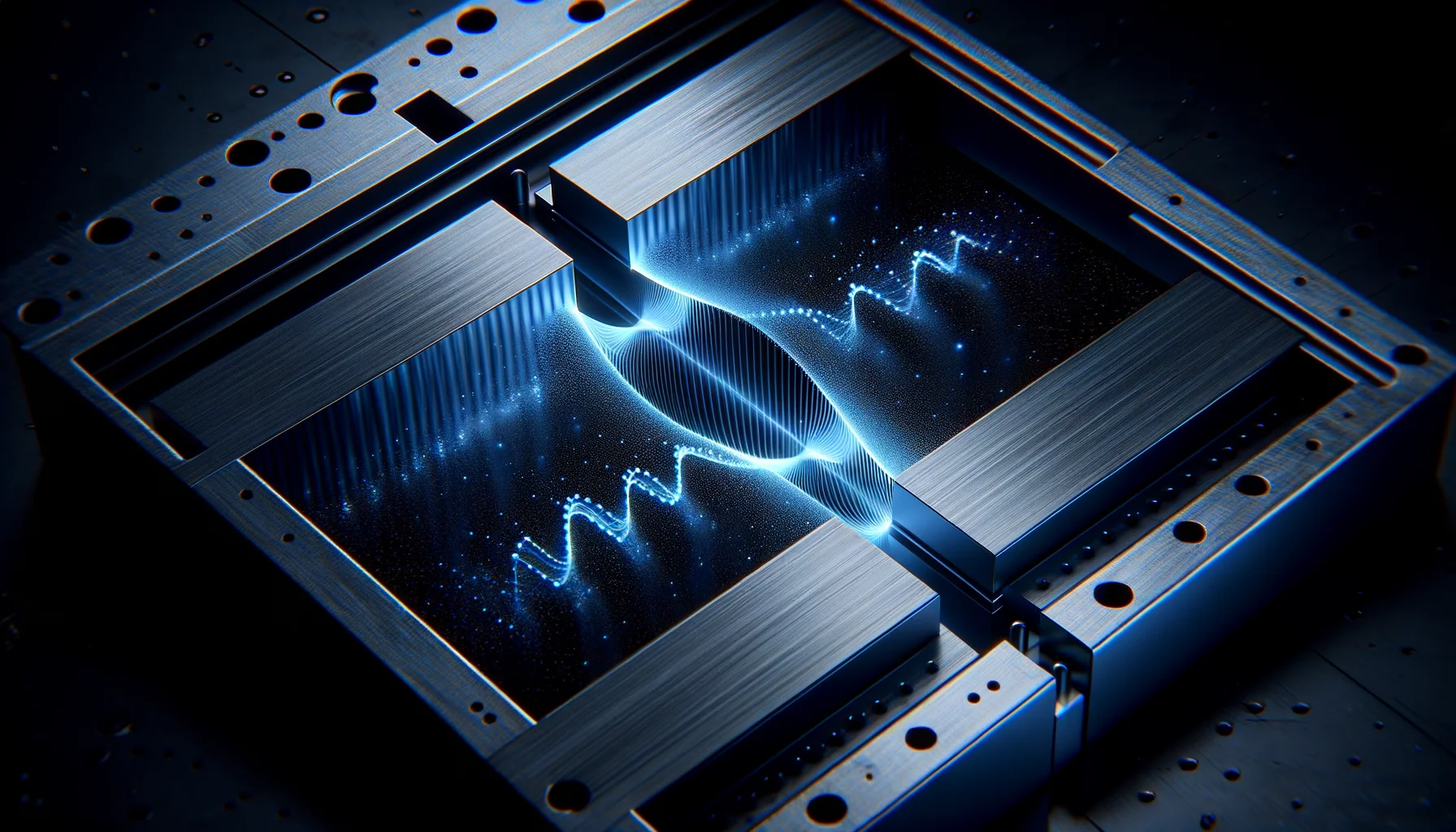
Open unverified legacy reading candidates
These retained citations have not been reviewed as a collection. Metadata, relevance and any linked performance claims require verification against the original work. Inclusion is not endorsement and none supplies evidence beyond the explicitly cited primary sources above.
- The particle problem in the general theory of relativity — Einstein, A. and Rosen, N. Phys. Rev. 48, 73–77 (1935).
- Geons — Wheeler, J. A. Phys. Rev. 97, 511–536 (1955).
- Wormholes in spacetime and their use for interstellar travel — Morris, M. S. and Thorne, K. S. Am. J. Phys. 56, 395–412 (1988).
- Wormholes, time machines, and the weak energy condition — Morris, M. S., Thorne, K. S. and Yurtsever, U. Phys. Rev. Lett. 61, 1446–1449 (1988).
- Traversable wormholes from surgically modified Schwarzschild spacetimes — Visser, M. Nucl. Phys. B 328, 203–212 (1989).
- Traversable wormholes: Some simple examples — Visser, M. Phys. Rev. D 39, 3182–3184 (1989).
- Lorentzian Wormholes: From Einstein to Hawking — Visser, M. AIP Press, New York (1995).
- Natural wormholes as gravitational lenses — Cramer, J. G. et al. Phys. Rev. D 51, 3117–3120 (1995).
- Topological censorship — Friedman, J. L., Schleich, K. and Witt, D. M. Phys. Rev. Lett. 71, 1486–1489 (1993).
- Lorentzian wormholes in Einstein-Gauss-Bonnet theory — Bhawal, B. and Kar, S. Phys. Rev. D 46, 2464–2468 (1992).
- Lorentzian wormholes in higher derivative gravity — Hochberg, D. Phys. Lett. B 251, 349–354 (1990).
- Lorentzian wormholes from the gravitationally squeezed vacuum — Hochberg, D. and Kephart, T. W. Phys. Lett. B 268, 377–383 (1991).
- Inflating Lorentzian wormholes — Roman, T. A. Phys. Rev. D 47, 1370–1379 (1993).
- On the attraction between two perfectly conducting plates — Casimir, H. B. G. Proc. Kon. Nederl. Akad. Wetenschap. 51, 793–795 (1948).
- Demonstration of the Casimir force — Lamoreaux, S. K. Phys. Rev. Lett. 78, 5–8 (1997).
- Averaged energy conditions and quantum inequalities — Ford, L. H. and Roman, T. A. Phys. Rev. D 51, 4277–4286 (1995).
- Quantum field theory constrains traversable wormhole geometries — Ford, L. H. and Roman, T. A. Phys. Rev. D 53, 5496–5507 (1996).
- Energy conditions in general relativity and quantum field theory — Kontou, E. and Sanders, K. Class. Quantum Grav. 37, 193001 (2020).
- Squeezed states of light — Walls, D. F. Nature 306, 141–146 (1983).
- Observation of squeezed light with 10 dB quantum noise reduction — Vahlbruch, H. et al. Phys. Rev. Lett. 100, 033602 (2008).
- Detection of 15 dB squeezed states of light — Vahlbruch, H. et al. Phys. Rev. Lett. 117, 110801 (2016).
- Repulsive Casimir force using metamaterials — Zhao, R. et al. Phys. Rev. Lett. 123, 150603 (2019).
- Quantum electromagnetic zero-point energy of a conducting spherical shell — Boyer, T. H. Phys. Rev. 174, 1764–1776 (1968).
- The Quantum Vacuum: An Introduction to Quantum Electrodynamics — Milonni, P. W. Academic Press, New York (1994).
- Chronology protection conjecture — Hawking, S. W. Phys. Rev. D 46, 603–611 (1992).
- Do vacuum fluctuations prevent the creation of closed timelike curves? — Kim, S. W. and Thorne, K. S. Phys. Rev. D 43, 3929–3947 (1991).
- Cauchy problem in spacetimes with closed timelike curves — Friedman, J. et al. Phys. Rev. D 42, 1915–1930 (1990).
- From wormhole to time machine — Visser, M. Phys. Rev. D 47, 554–565 (1993).
- Billiard balls in wormhole spacetimes with closed timelike curves — Echeverria, F., Klinkhammer, G. and Thorne, K. S. Phys. Rev. D 44, 1077–1099 (1991).
- Quantum Fields in Curved Space — Birrell, N. D. and Davies, P. C. W. Cambridge University Press (1982).
- Quantum Field Theory in Curved Spacetime and Black Hole Thermodynamics — Wald, R. M. University of Chicago Press (1994).
- Semiclassical gravity theory and quantum fluctuations — Kuo, C.-I. and Ford, L. H. Phys. Rev. D 47, 4510–4519 (1993).
- Aspects of Quantum Field Theory in Curved Space-Time — Fulling, S. A. Cambridge University Press (1989).
- Gravitation — Misner, C. W., Thorne, K. S. and Wheeler, J. A. W. H. Freeman (1973).
- The Large Scale Structure of Space-Time — Hawking, S. W. and Ellis, G. F. R. Cambridge University Press (1973).
- General Relativity — Wald, R. M. University of Chicago Press (1984).
- Spacetime and Geometry — Carroll, S. Cambridge University Press (2004).
- Theory and Experiment in Gravitational Physics — Will, C. M. Cambridge University Press, 2nd ed. (1993).
- Advanced Space Propulsion Based on Vacuum (Spacetime Metric) Engineering — Puthoff, H. E. arXiv:1204.2184 (2012).
- Polarizable-Vacuum Approach to General Relativity — Puthoff, H. E. Found. Phys. 32, 927–943 (2002).
- Engineering the Zero-Point Field and Polarizable Vacuum for Interstellar Flight — Puthoff, H. E., Little, S. R. and Ibison, M. J. British Interplanetary Soc. 55, 137–144 (2002).
- Wormholes in spacetime and their use for interstellar travel — Morris, M. S. and Thorne, K. S. Am. J. Phys. 56, 395–412 (1988).
- Frontiers of Propulsion Science — Millis, M. G. and Davis, E. W. (eds.) AIAA (2009).
- Teleportation Physics Study — Davis, E. W. AFRL-PR-ED-TR-2003-0301, Air Force Research Laboratory (2004).
- Warp Field Mechanics 101 — White, H. G. NASA Johnson Space Center (2011).
- Warp Field Mechanics 102: Energy Optimization — White, H. G. NASA Johnson Space Center (2013).
- Worldline numerics applied to custom Casimir geometry generates unanticipated intersection with Alcubierre warp metric — White, H. et al. Eur. Phys. J. C 81, 677 (2021).
- Craft Using an Inertial Mass Reduction Device — Pais, S. C. US20170313446A1 (2017).
- Electromagnetic Field Generator — Pais, S. C. US10135366B2 (2018).
- High Frequency Gravitational Wave Generator — Pais, S. C. US10322827B2 (2019).
- Plasma Compression Fusion Device — Pais, S. C. US20190295733A1 (2019).
- Magnetohydrodynamic Propulsion Apparatus — US3322374A (1967).