Metric Infrastructure
THE ATLAS — SPACETIME ENGINEERING DESIGN SURVEY
Before the first door opens, every geometry is compiled. The Atlas is the division's standing answer to a question physics has never tabulated: for a fixed stress-energy budget and known physical law, which distributions of energy, momentum, and stress buy the most of each geometric feature of spacetime?
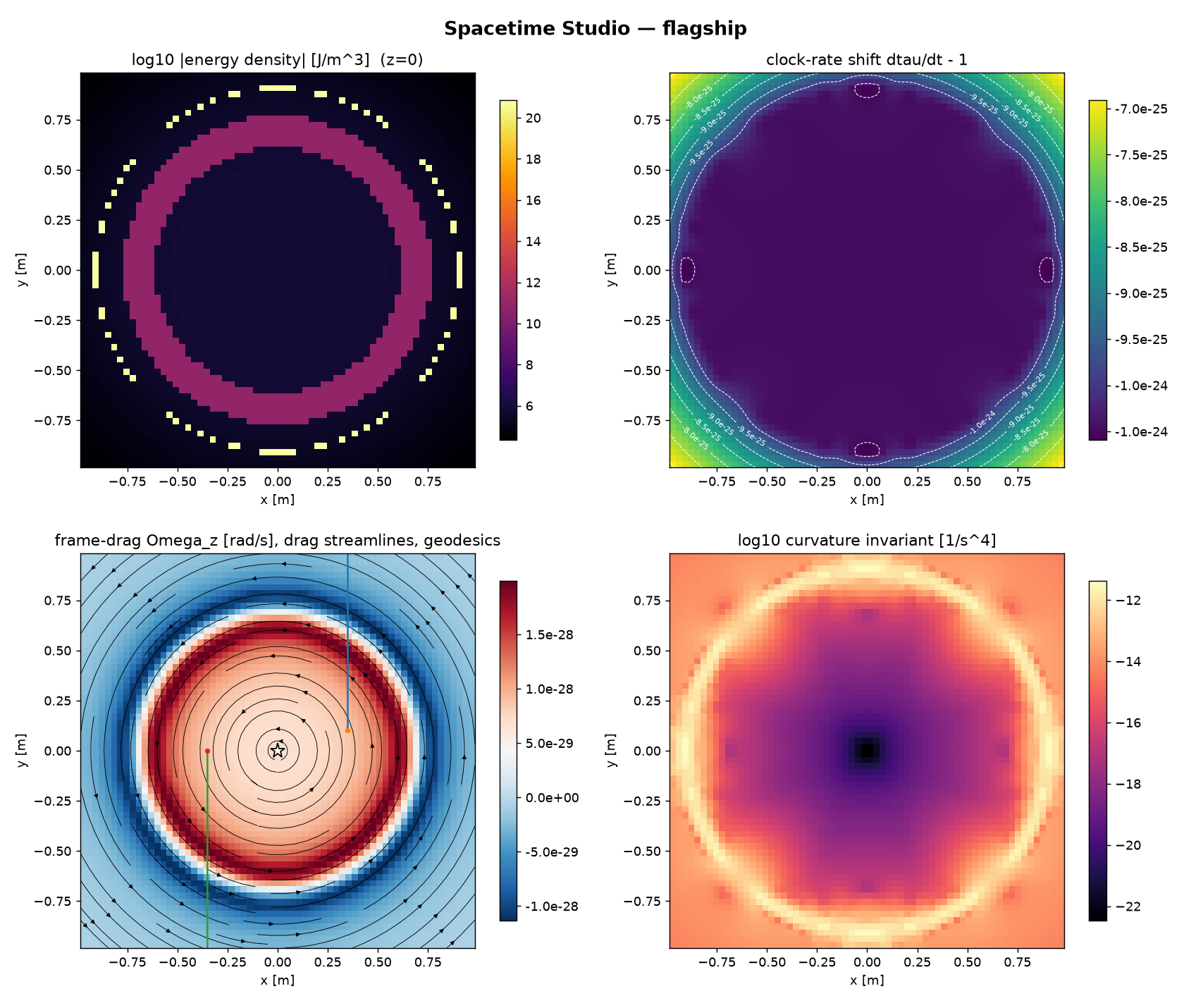
SPACETIME STUDIO — ONE COMPILED MACHINE: ENERGY, CLOCKS, DRAG, CURVATURE
01 // The Instrument
Spacetime Studio is the division's hardware-to-geometry compiler. Its primitive is not a laser or a coil — it is the stress-energy voxel. Photon rings, plasma toroids, resonant cavities, Casimir stacks, and energy shells lower to one tensor field Tμν(x,y,z); the linearized Einstein equations are solved for the metric; clock rates, frame dragging, tidal gradients, and geodesics are read off the result. The solver is pinned to analytic relativity before any design run counts: the Newtonian exterior, interior clock slowdown, the rotating-shell dragging law Ω = 4GMω/3c²R, and exact cancellation for counter-rotating rings.
02 // The Question
Human intuition optimizes one knob at a time. The Atlas does not. Each cell of the survey hands 52 hardware parameters — ring heights, radii, powers, directions, plasma density and flow, cavity placement, shell radius and spin, Casimir gap — to a gradient optimizer that differentiates through the Einstein equations themselves, from three independent starting basins, 300 steps each. The budget is the law: capped for maximization objectives, pinned for interior flatness, where the machine must carry every joule and still keep the payload quiet.
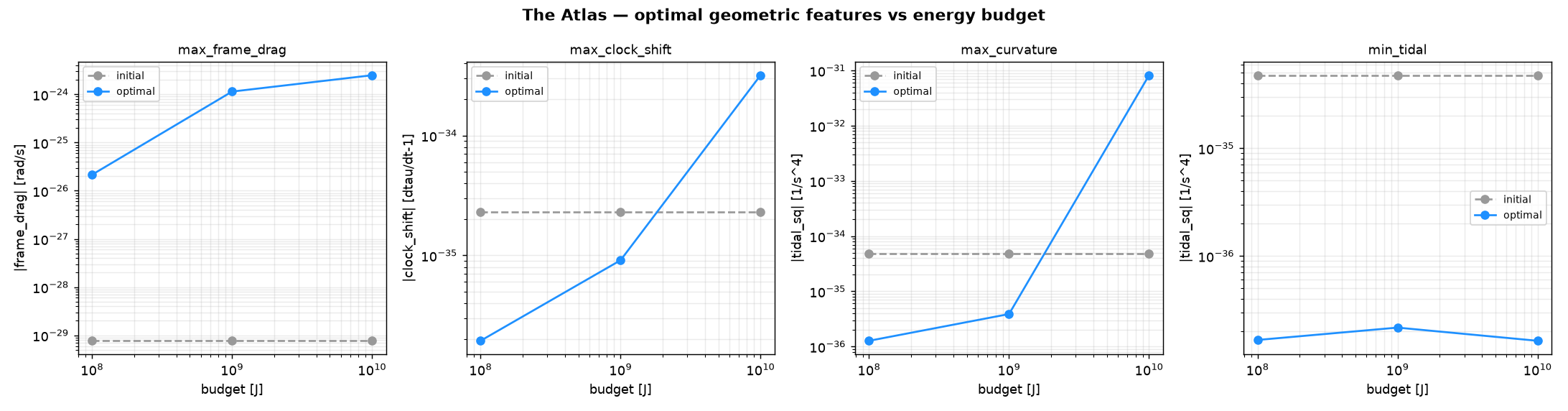
THE FRONTIER CURVES — EACH FEATURE’S OPTIMUM VS ENGINEERABLE BUDGET
03 // The Survey
| FEATURE | BUDGET | OPTIMUM | WINNING START | BUDGET RULE |
|---|---|---|---|---|
| Frame dragging | 1.00 × 10⁷ J | 6.00 × 10⁻³⁰ rad/s | shell | cap |
| Frame dragging | 1.00 × 10⁸ J | 1.07 × 10⁻²⁶ rad/s | shell | cap |
| Frame dragging | 1.00 × 10⁹ J | 2.26 × 10⁻²⁵ rad/s | shell | cap |
| Frame dragging | 1.00 × 10¹⁰ J | 2.50 × 10⁻²⁴ rad/s | rings | cap |
| Frame dragging | 1.00 × 10¹¹ J | 2.51 × 10⁻²⁴ rad/s | rings | cap |
| Clock-rate depth | 1.00 × 10⁷ J | 3.61 × 10-37 Δτ/τ | shell | cap |
| Clock-rate depth | 1.00 × 10⁸ J | 7.32 × 10-37 Δτ/τ | shell | cap |
| Clock-rate depth | 1.00 × 10⁹ J | 9.13 × 10-36 Δτ/τ | shell | cap |
| Clock-rate depth | 1.00 × 10¹⁰ J | 3.24 × 10⁻³⁴ Δτ/τ | shell | cap |
| Clock-rate depth | 1.00 × 10¹¹ J | 1.43 × 10⁻³³ Δτ/τ | shell | cap |
| Curvature density | 1.00 × 10⁷ J | 9.48 × 10-38 s−4 | shell | cap |
| Curvature density | 1.00 × 10⁸ J | 9.12 × 10-38 s−4 | shell | cap |
| Curvature density | 1.00 × 10⁹ J | 3.88 × 10-36 s−4 | rings | cap |
| Curvature density | 1.00 × 10¹⁰ J | 8.29 × 10⁻³² s−4 | shell | cap |
| Curvature density | 1.00 × 10¹¹ J | 1.41 × 10⁻³⁰ s−4 | shell | cap |
| Interior flatness | 1.00 × 10⁷ J | 9.48 × 10-38 s−4 | shell | pin |
| Interior flatness | 1.00 × 10⁸ J | 1.66 × 10-37 s−4 | shell | pin |
| Interior flatness | 1.00 × 10⁹ J | 2.16 × 10-37 s−4 | shell | pin |
| Interior flatness | 1.00 × 10¹⁰ J | 1.63 × 10-37 s−4 | shell | pin |
| Interior flatness | 1.00 × 10¹¹ J | 4.75 × 10⁻³³ s−4 | shell | pin |
04 // What The Optimizer Chose
The configurations are not designed; they are found. At the top budget the dragging cell rediscovered the 2GJ/c²r³ law unaided — every ring collapsed onto the payload plane at the closest allowed radius, co-rotating at full power, the plasma flow reversed to add its angular momentum. The flatness cell reached for the oldest theorem in gravity: a spherical shell’s interior potential is constant, so the machine that must carry 1.00 × 10¹¹ J and keep its payload tide-free routes the budget into the shell.
Frame dragging @ 1.00 × 10¹¹ J — rotational spacetime entrainment at the payload
ring[0]: cz=2.7985e-08, radius=0.20047, power=9.9964e+07, direction=0.99907
ring[1]: cz=-3.0543e-09, radius=0.20052, power=9.9955e+07, direction=0.99878
ring[2]: cz=-8.5877e-09, radius=0.20056, power=9.9951e+07, direction=0.99865
ring[3]: cz=1.1526e-09, radius=0.20057, power=9.995e+07, direction=0.99861
ring[4]: cz=-1.1526e-09, radius=0.20057, power=9.995e+07, direction=0.99861
ring[5]: cz=8.5877e-09, radius=0.20056, power=9.9951e+07, direction=0.99865
ring[6]: cz=3.0543e-09, radius=0.20052, power=9.9955e+07, direction=0.99878
ring[7]: cz=-2.7985e-08, radius=0.20047, power=9.9964e+07, direction=0.99907
toroid[8]: cz=-8.9349e-06, major_r=0.30023, density=1.9957e+21, temperature_eV=2000, flow_velocity=9.9917e+05Interior flatness @ 1.00 × 10¹¹ J — residual tide while carrying the full budget
ring[0]: cz=-0.35194, radius=0.84953, power=9.9421e+07, direction=0.49435
ring[1]: cz=-0.25588, radius=0.84953, power=9.9421e+07, direction=0.49154
ring[2]: cz=-0.1574, radius=0.84953, power=9.9421e+07, direction=0.48903
ring[3]: cz=-0.053527, radius=0.84953, power=9.9421e+07, direction=0.48749
ring[4]: cz=0.053451, radius=0.84953, power=9.9421e+07, direction=0.48748
ring[5]: cz=0.15736, radius=0.84953, power=9.9421e+07, direction=0.489
ring[6]: cz=0.25587, radius=0.84953, power=9.9421e+07, direction=0.49151
ring[7]: cz=0.35194, radius=0.84953, power=9.9421e+07, direction=0.49432
toroid[8]: cz=0.021519, major_r=0.84978, density=1.9883e+21, temperature_eV=100.76, flow_velocity=-0.008340405 // The Time Domain
The static atlas is the map of what a frozen machine can hold. The time domain is what a driven machine can broadcast. The instrument now solves both zones of a modulated source: the adiabatic near zone, where the payload’s clock rate breathes in step with the drive, and the radiation zone, where the machine’s oscillating quadrupoles launch real gravitational waveforms. The reference source — two ten-kilogram masses on a half-meter arm at ten kilohertz — reproduces the closed-form strain amplitude and the Landau–Lifshitz radiated power to four significant figures, with every watt at exactly twice the rotation frequency. Both radiation channels are live: the mass quadrupole and, for spinning-shell machines, the current quadrupole, each pinned to its power formula by sphere-integrated flux.
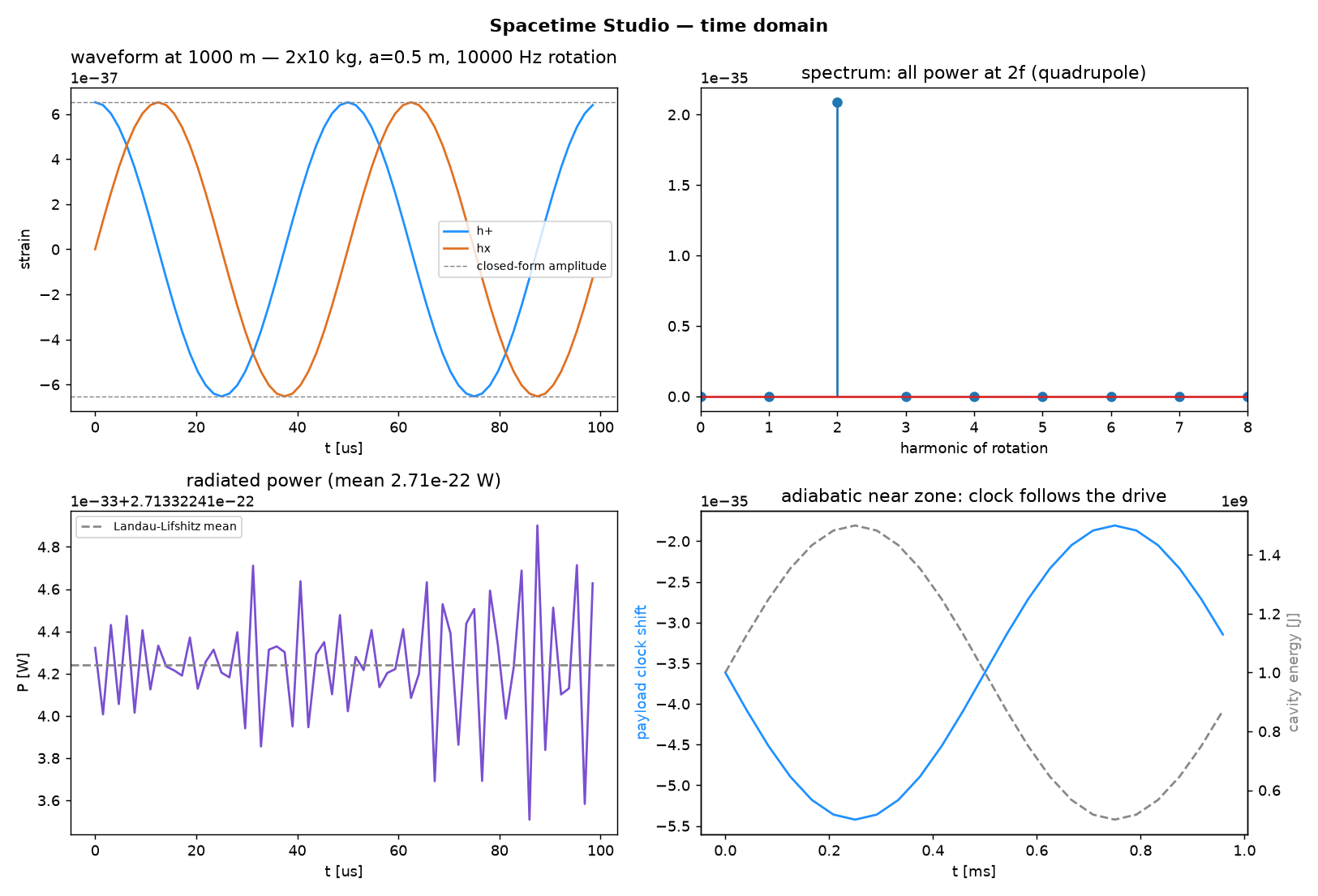
THE TIME DOMAIN — WAVEFORMS, SPECTRUM, POWER, AND THE BREATHING CLOCK
06 // The Warp Ledger
The instrument now runs in the direction the product requires: geometry first. The curvature engine takes the warp metric itself — no weak-field approximation — computes its full Einstein tensor numerically on the grid, and reads off the stress-energy the geometry demands. The certificate: the numerical result reproduces the closed-form Alcubierre energy density to 4 percent, converging with resolution. The engine can now price any metric ansatz.
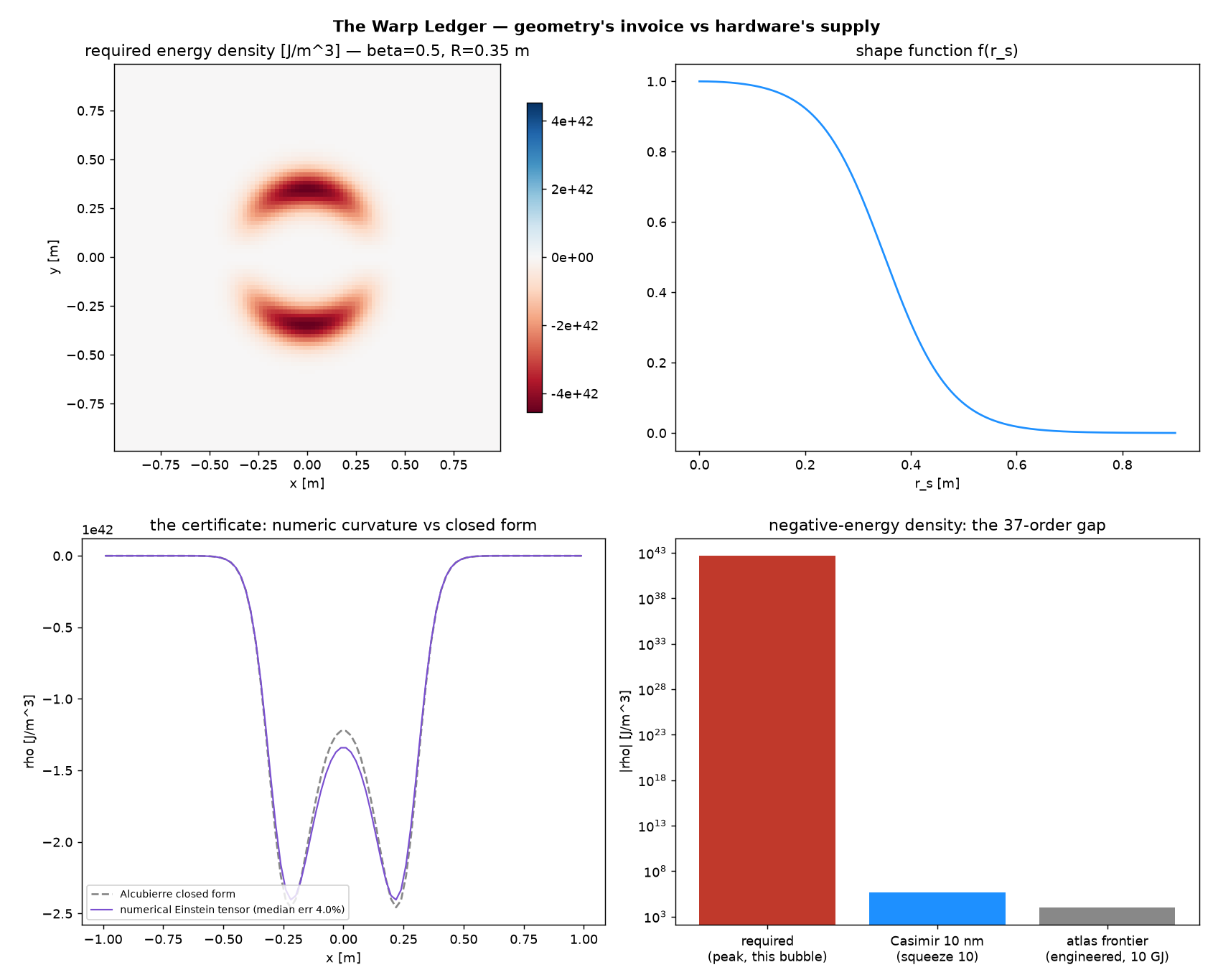
THE INVOICE — REQUIRED DENSITY, THE CERTIFICATE, AND THE GAP
The invoice for a 0.35 m cabin at 0.5 c: -8.64 × 1041 J of negative energy — 9.62 × 1024 kg, about one and a half Earth masses, with the opposite sign — at a peak density of 4.66 × 1042 J/m³. Our best physical negative-energy hardware (Casimir stacks at a 10 nm gap, squeezed) supplies 4.33 × 10⁵ J/m³. The gap is 37 orders of magnitude, and it does not soften with modesty:
| BUBBLE VELOCITY | NEGATIVE MASS REQUIRED | PEAK DENSITY |
|---|---|---|
| 0.01 c | 3.82 × 10²¹ kg | 1.76 × 1039 J/m³ |
| 0.10 c | 3.82 × 10²³ kg | 1.76 × 1041 J/m³ |
| 0.50 c | 9.54 × 1024 kg | 4.41 × 1042 J/m³ |
| 0.99 c | 3.73 × 1025 kg | 1.73 × 1043 J/m³ |
The engine prices the whole warp family through one certified pipeline — Alcubierre, Natario (a divergence-free bubble whose traveller feels no tidal compression), and Van Den Broeck (a microscopic wall wrapping a macroscopic pocket). Zero expansion does not repeal the null energy condition; every geometry still demands negative energy of the same astronomical order.
| GEOMETRY | NEGATIVE MASS | PEAK DENSITY | SIGNATURE |
|---|---|---|---|
| Alcubierre | 9.62 × 1024 kg | 4.66 × 1042 J/m³ | |
| Natario | 3.27 × 1025 kg | 1.41 × 1043 J/m³ | θ_wall 2.13 × 10⁻³ (zero-expansion) |
| VanDenBroeck | 4.33 × 1027 kg | 2.47 × 1046 J/m³ | pocket volume ×6e+05 |
This is the honest state of warp engineering: the requirements document now exists, computed rather than estimated, and every candidate mechanism — each of the Five Doors — can be priced against it. The most developed of those doors has its own study: the tensor-matched Casimir array, which optimizes every component of the stress-energy tensor and reports exactly how many orders of magnitude remain. The ledger is the map of how far the doors have to open.
07 // The Honest Ledger
Every number above is weak-field general relativity at laboratory scale, and laboratory scale is humble: the best dragging on this page is 2.51 × 10⁻²⁴ rad/s; the flattest carried interior sits at 9.48 × 10-38 s−4 of residual tide; the reference rotor radiates 2.71 × 10⁻²² W of gravitational waves. The Atlas is the map, not the territory — but it is a map nobody has drawn before, and each survey pass extends it: denser budget ladders, time-domain sources, stronger-field solvers behind the same compiler. The route from this page to the product line runs through every cell of this table.